High Performance Computing
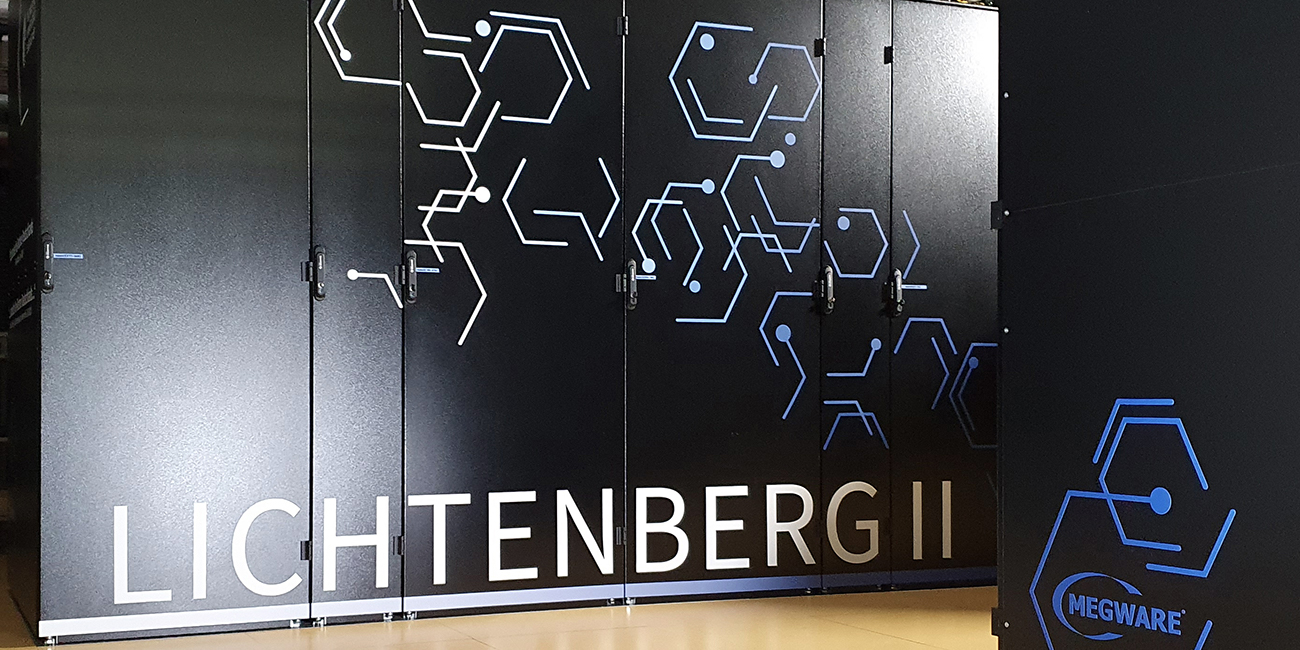
The series of Lichtenberg high-performance computers at TU Darmstadt provides computing resources for researchers from academia and public research facilities in Germany. The multifaceted architecture of the high performance computer allows for flexible and efficient scientific computing, especially for computationally intensive applications.
The Lichtenberg II system
In 2020, the first expansion stage of the Lichtenberg II system with 643 computing nodes was put into operation; this will be expanded by 581 computing nodes with the second expansion stage. Together, the two expansion stages will provide a theoretical peak performance of approximately 8.5 petaflops per second (PFlop/s) through processors and 1.7 petaflops per second through accelerators. The main memory totals 563 terabytes, the storage system for data around 6 petabytes.
Highly efficient energy management concept
Energy-efficient computer systems and sustainable use are key goals for TU Darmstadt. For this reason, the waste heat from Lichtenberg II is not simply released into the environment, but during the heating period, a significant portion is fed into the district heating network that connects all buildings on the Lichtwiese campus.
For this purpose, Lichtenberg II uses direct and highly efficient hot water cooling to fully utilize the power of the processors. In the process, special heat exchangers and coolant distributors enable high return temperatures of more than 45 degrees Celsius to ensure sensible reuse of energy and efficient cooling. This leads to a significantly improved CO2 and energy balance and is an important step towards sustainable high-performance computing.
-
![Systems unavailable]()
![Systems unavailable]()
Lichtenberg Cluster temporarily closed on short notice
October 19, 2026
OS security issues
UPDATE 2026-10-19, 4pm The Lichtenberg cluster is open again, and all the queues have been re-activated.
-
![]()
![]()
New, Simplified Application Process for Courses, Workshops, and Classes
October 12, 2026
A new, entirely digital process using JARDS@TUDa and Moodle.
The new process has replaced the previous paperwork involving signed applications and user regulations. Its primary purpose is to reduce the administrative burden on the instructors in charge—especially for larger courses—and to enable course accounts to be set up more quickly.
-
![]()
![]()
Lichtenberg cluster re-opened
August 28, 2026
with a workaround
This workaround can lead to issues with the software stack.